
Global Medical Services
International Medical Center
 Diseases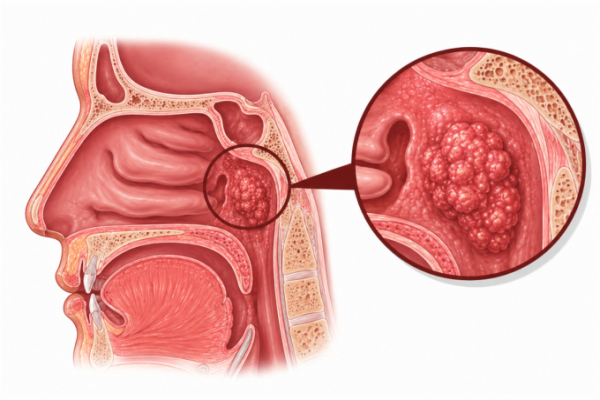
Nasopharyngeal carcinoma (NPC) is a cancer originating in the nasopharynx. Learn about its causes, symptoms, treatment approaches, and prognosis at Guangzhou Fosun Chancheng Hospital.
NPC is a squamous cell carcinoma of the nasopharynx with a unique geographic distribution, most common in southern China and Southeast Asia:
EBV Infection: EBV DNA is found in virtually all non-keratinizing NPC cells. EBV latent proteins (LMP1, LMP2) drive proliferation and inhibit apoptosis.
Genetic Susceptibility: Familial aggregation with 4-10x increased risk in first-degree relatives. HLA-A2 and HLA-B46 haplotypes increase risk in southern Chinese.
Dietary Factors: Salt-preserved foods (Cantonese salted fish) containing volatile nitrosamines, especially with early childhood exposure.
Environmental: Wood dust, formaldehyde exposure. Smoking and alcohol increase risk for keratinizing subtype.
Demographics: Male:female ratio 2-3:1. Bimodal age peaks at 15-25 and 50-60 years.
Neck Mass: Most common presentation (60-90%). Firm, non-tender cervical lymphadenopathy in upper jugular or posterior triangle. Often the only presenting sign.
Nasal Symptoms: Nasal obstruction, epistaxis, blood-tinged nasal discharge, postnasal drip, hyposmia.
Aural Symptoms: Unilateral conductive hearing loss, tinnitus, aural fullness, recurrent serous otitis media from Eustachian tube obstruction.
Neurological Symptoms: Cranial nerve palsies (CN III-VI causing diplopia, facial numbness; CN IX-XII causing dysphagia, hoarseness, tongue deviation) from skull base extension. Persistent headache suggests intracranial involvement.
Distant Metastasis: Bone pain, respiratory symptoms (lung metastases), hepatomegaly (liver involvement). NPC has high metastatic potential.
Radiation Therapy: Primary treatment. IMRT delivers 66-70 Gy to tumor and nodes while sparing critical structures. Local control >90% for stage I-II.
Chemotherapy: Concurrent cisplatin-based chemoradiotherapy for stage II-IVA. Induction chemotherapy (docetaxel/cisplatin/5-FU or gemcitabine/cisplatin) before CCRT reduces distant metastasis. Adjuvant chemotherapy for high-risk patients.
Targeted Therapy & Immunotherapy: EGFR inhibitors (cetuximab), PD-1 checkpoint inhibitors (nivolumab, pembrolizumab, camrelizumab) for recurrent/metastatic disease.
Surgery: Limited role - salvage neck dissection for persistent nodal disease, nasopharyngectomy for small localized recurrence.
EBV DNA Monitoring: Plasma EBV DNA used for screening, response monitoring, and recurrence surveillance.
Overall Survival: 5-year survival: Stage I >95%, Stage II 85-90%, Stage III 70-80%, Stage IVA 60-70%, Stage IVB 30-50%. IMRT significantly improves outcomes.
Prognostic Factors (favorable): Younger age, female gender, non-keratinizing histology, low pretreatment EBV DNA (<500>
Prognostic Factors (unfavorable): High pretreatment EBV DNA (>4000 copies/mL), persistent detectable EBV DNA after treatment, cranial nerve involvement, skull base erosion, distant metastasis at diagnosis, elevated LDH.
Recurrence: Most recurrences within 2-3 years. Local recurrence 10-20%, regional 5-10%, distant 15-30%. Late recurrences (>5 years) are rare but possible.
Late Effects: Xerostomia, hearing loss, temporal lobe necrosis, cranial neuropathy, hypothyroidism, carotid stenosis, secondary malignancies (radiation-induced).
Screening: High-risk populations (southern Chinese ethnicity, family history) benefit from EBV IgA serology (VCA-IgA, EA-IgA) and plasma EBV DNA screening. Nasopharyngoscopy for persistent unilateral symptoms.
Dental Evaluation: Comprehensive dental assessment and preradiation extractions (non-restorable teeth) at least 2 weeks before RT. Daily fluoride application during and after RT to prevent radiation caries.
Speech & Swallowing: Pretreatment and ongoing speech-language pathology evaluation. Swallowing exercises during RT reduce late dysphagia. Percutaneous gastrostomy if significant weight loss expected.
Hearing Monitoring: Baseline and serial audiometry. Cisplatin ototoxicity monitoring.
Post-Treatment Surveillance: EBV DNA monitoring every 3-6 months for first 2 years, then every 6-12 months. Annual nasopharyngoscopy, thyroid function, dental follow-up.
Lifestyle: Smoking cessation, limit alcohol, avoid salted fish.
Concerned about Nasopharyngeal Carcinoma? Submit your medical records for a professional evaluation.
Upload Documents View Patient CasesPrepare pathology reports, imaging scans, genetic testing reports and prior treatment records for faster review.