
Global Medical Services
International Medical Center
 Diseases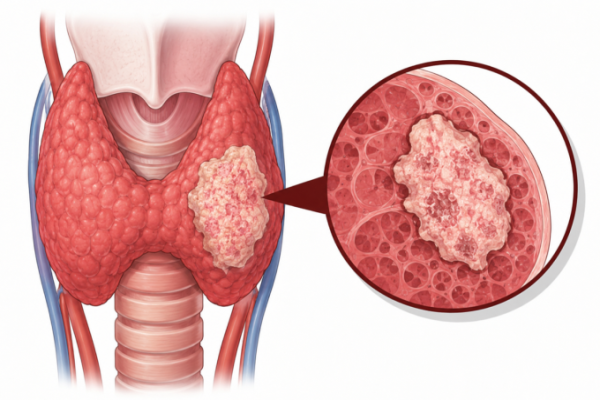
Thyroid cancer is the most common endocrine malignancy. Learn about its types, causes, symptoms, diagnosis, treatment, and prognosis at Guangzhou Fosun Chancheng Hospital.
Thyroid cancer arises from thyroid follicular or parafollicular C-cells, with incidence rising worldwide due to improved detection:
Radiation Exposure: Ionizing radiation, especially childhood head/neck irradiation or nuclear fallout (Chernobyl). Risk inversely proportional to age at exposure. Latency 5-30 years.
Genetic Mutations: PTC: BRAF V600E (60%), RET/PTC rearrangements (20%), RAS mutations. FTC: RAS mutations, PAX8-PPARγ rearrangement. MTC: RET proto-oncogene germline mutations (MEN2 syndromes) or somatic RET mutations. ATC: TP53, CTNNB1 mutations.
Iodine Intake: Iodine deficiency associated with follicular carcinoma; iodine excess linked to papillary carcinoma.
Genetic Syndromes: Familial adenomatous polyposis (FAP), Cowden syndrome (PTEN), Carney complex, Werner syndrome, MEN2A/MEN2B (RET mutations).
Demographics: Female:male ratio 3:1. Peak incidence age 30-50 for PTC, 40-60 for FTC, 50-60 for MTC, 65+ for ATC.
Thyroid Nodule: Most common presentation. Solitary, firm, non-tender nodule. Rapid growth suggests aggressive histology.
Compressive Symptoms: Dysphagia (esophageal compression), dyspnea/stridor (tracheal compression), hoarseness (recurrent laryngeal nerve involvement).
Cervical Lymphadenopathy: Enlarged, firm cervical lymph nodes, especially in levels II-VI. May be cystic in papillary carcinoma.
MTC-Specific: Diarrhea (calcitonin-induced), flushing (from vasoactive peptides).
ATC-Specific: Rapidly enlarging neck mass, pain, dysphagia, dyspnea, vocal cord paralysis, hoarseness. Often presents with locally advanced disease and distant metastases.
Distant Metastases: Lung (most common for DTC), bone (lytic lesions), liver (MTC), brain.
Surgery: Thyroid lobectomy for low-risk PTC <1cm>1cm, bilateral disease, lymph node metastases, extrathyroidal extension, or high-risk histology. Central compartment (level VI) lymph node dissection for clinically node-positive disease. Therapeutic lateral neck dissection for confirmed metastases.
Radioactive Iodine (RAI): I-131 ablation for intermediate/high-risk DTC after thyroidectomy. Requires TSH stimulation (>30 mIU/L) via thyroid hormone withdrawal or recombinant TSH. Post-treatment whole-body scan for staging.
TSH Suppression: Levothyroxine to suppress TSH <0>
Targeted Therapy: Multikinase inhibitors (sorafenib, lenvatinib) for RAI-refractory DTC. Selective RET inhibitors (selpercatinib, pralsetinib) for RET-mutant MTC. BRAF/MEK inhibitors (dabrafenib/trametinib) for BRAF V600E-mutant ATC.
External Beam Radiation: Adjuvant EBRT for gross residual disease, unresectable disease, or ATC.
Papillary Thyroid Carcinoma: 10-year survival >95% for low-risk. Negative prognostic factors: age >55, tumor >4cm, extrathyroidal extension, lymph node metastases >3cm, distant metastases, tall cell variant.
Follicular Thyroid Carcinoma: 10-year survival 85-90%. Negative factors: age >55, vascular invasion, distant metastases, widely invasive subtype.
Medullary Thyroid Carcinoma: 10-year survival 75% (localized), 40% (regional). Negative factors: age >55, stage IV, high preoperative calcitonin, RET M918T mutation, incomplete surgical resection.
Anaplastic Thyroid Carcinoma: Median survival 3-6 months. 1-year survival <20>70, leukocytosis, tumor >5cm, distant metastases.
Risk Stratification (ATA): Dynamic risk assessment based on response to therapy: excellent (no evidence of disease), biochemical incomplete, structural incomplete, indeterminate.
Screening: Routine ultrasound screening not recommended for general population. Screen high-risk (childhood radiation, MEN2 family, FAP, Cowden syndrome) with neck ultrasound ± calcitonin.
Postoperative Monitoring: Thyroglobulin (Tg) and anti-Tg antibodies for DTC - measured every 6-12 months. Calcitonin and CEA for MTC. Neck ultrasound at 6-12 months post-surgery, then annually.
RAI Precautions: Low-iodine diet 1-2 weeks before RAI. Pregnancy test required (contraindicated in pregnancy). Radiation safety: avoid close contact with others, separate bathroom, no pregnancy for 6-12 months post-RAI.
Calcium Monitoring: Monitor calcium and PTH post-thyroidectomy. Hypoparathyroidism risk requires calcium and vitamin D supplementation.
Lifestyle: Lifelong levothyroxine adherence. Avoid iodine-containing supplements/contrast unless medically necessary. Regular dental care (xerostomia from RAI). Smoking cessation.
Concerned about Thyroid Cancer? Submit your medical records for a professional evaluation.
Upload Documents View Patient CasesPrepare pathology reports, imaging scans, genetic testing reports and prior treatment records for faster review.