
Global Medical Services
International Medical Center
 Diseases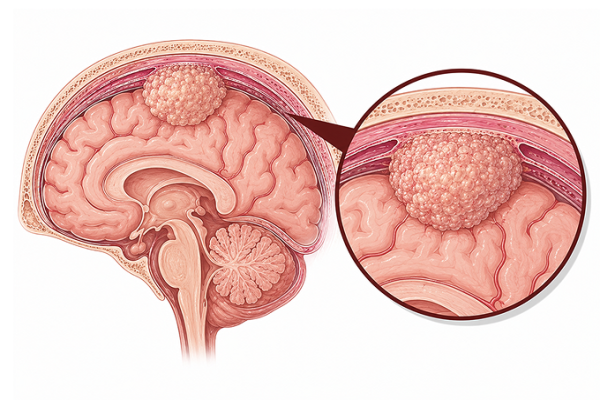
Meningioma is a tumor arising from the meninges, the protective layers surrounding the brain and spinal cord. Learn about its types, symptoms, treatment, and prognosis at Guangzhou Fosun Chancheng Hos
Meningiomas arise from arachnoid cap cells of the meninges. They are the most common primary CNS tumor (39% of all primary brain tumors, 55% of benign brain tumors):
Ionizing Radiation: Strongest known risk factor. Prior cranial radiation (tinea capitis, childhood cancer survivors). Latency 20-35 years. Dose-dependent risk.
Genetic Factors: NF2 gene mutations (chromosome 22q12): loss of merlin protein function. Somatic NF2 mutations in 40-60% of sporadic meningiomas. Non-NF2 mutations: AKT1, SMO, TRAF7, KLF4, POLR2A. Chromosomal abnormalities: monosomy 22 most common.
Hormonal Factors: Female predominance (2-3:1), especially for WHO grade 1. Expression of progesterone receptors (PR) in majority. Growth during pregnancy, luteal phase of menstrual cycle. Association with breast cancer.
Genetic Syndromes: Neurofibromatosis type 2 (NF2): bilateral vestibular schwannomas + multiple meningiomas. Gorlin syndrome, Cowden syndrome, Werner syndrome, multiple endocrine neoplasia type 1.
WHO Grades: Grade 1 (benign, 80%): meningothelial, fibrous, transitional, psammomatous, angiomatous, secretory, etc. MIB-1 <4>20%.
Asymptomatic: Many meningiomas are incidental findings on brain imaging. Slow growth allows neural adaptation. Discovered in 1-2% of autopsy series.
Seizures: Most common presenting symptom (30-40%). More common with convexity and parasagittal meningiomas. Focal seizures correlating with tumor location.
Focal Neurological Deficits: Progressive weakness (parasagittal/falcine - leg, convexity - arm), sensory changes, visual field deficits (sphenoid wing, tuberculum sellae), anosmia (olfactory groove).
Headache: Non-specific, gradual onset. May be from dural stretching or increased ICP. Worse in morning.
Location-Specific: Cavernous sinus: diplopia, facial numbness, ptosis. Cerebellopontine angle: hearing loss, tinnitus, vertigo. Optic nerve sheath: proptosis, vision loss, optociliary shunt vessels. Tuberculum sellae: bitemporal hemianopsia, optic atrophy. Foramen magnum: suboccipital pain, extremity weakness/atrophy.
Cognitive/Personality Changes: Frontal meningiomas: apathy, disinhibition, executive dysfunction. May be misdiagnosed as depression or dementia.
Observation: For asymptomatic, small (<3cm>
Surgery: First-line treatment. Gross total resection (Simpson Grade I-II) is goal. Simpson grading correlates with recurrence: Grade I (complete resection of tumor + dural attachment + abnormal bone) 9% recurrence, Grade IV (subtotal) 44% recurrence. Skull base meningiomas more challenging (cranial nerve and vascular involvement).
Radiation Therapy: Stereotactic radiosurgery (SRS): for small (<3cm>
Systemic Therapy: Reserved for recurrent/progressive disease after surgery and RT exhaustion. Somatostatin analogues (octreotide), VEGF inhibitors (bevacizumab, sunitinib), mTOR inhibitors (everolimus). Limited efficacy.
WHO Grade 1: 5-year progression-free survival 85-95%, 10-year PFS 75-90%. Recurrence after gross total resection 7-23% at 10 years. 10-year overall survival 80-90%.
WHO Grade 2 (Atypical): 5-year PFS 50-60% after GTR. Recurrence 29-40% at 5 years. Adjuvant RT after GTR reduces recurrence. 10-year OS 70-80%.
WHO Grade 3 (Anaplastic): 5-year PFS 20-30%. Median OS 2-3 years. Adjuvant RT required regardless of extent of resection. High rate of distant metastases (lung, liver).
Prognostic Factors (favorable): WHO grade 1, gross total resection (Simpson I-II), female gender, younger age, convexity location, PR positivity, low MIB-1 index (<4>
Prognostic Factors (unfavorable): WHO grade 2-3, subtotal resection, male gender, older age, skull base location, brain invasion, high MIB-1 index, TERT promoter mutation, CDKN2A/B deletion.
Incidental Finding Management: MRI with contrast for characterization. Observation with serial imaging for small asymptomatic meningiomas. No need for immediate intervention in most incidental cases.
Pregnancy Considerations: Meningiomas may grow during pregnancy (progesterone receptors). Visual field testing and MRI without contrast if symptomatic during pregnancy. Defer elective surgery until postpartum.
Hormonal Therapy: Avoid or discontinue exogenous hormone therapy (HRT, OCP) in meningioma patients when possible. Discuss risk-benefit with gynecologist.
Postoperative Monitoring: MRI at 3 months post-surgery as new baseline. Then every 6-12 months for 2-3 years, annually for 5 years, then every 2-3 years. More frequent for grade 2-3.
Radiation Considerations: Risk of radiation-induced secondary tumors (very low). Cognitive effects with large volume fractionated RT. Optic neuropathy risk with SRS near optic apparatus (dose <8>
Lifestyle: No specific restrictions. Regular follow-up essential. Report new neurological symptoms promptly. Seizure precautions as indicated.
Concerned about Meningioma? Submit your medical records for a professional evaluation.
Upload Documents View Patient CasesPrepare pathology reports, imaging scans, genetic testing reports and prior treatment records for faster review.