
Global Medical Services
International Medical Center
 Diseases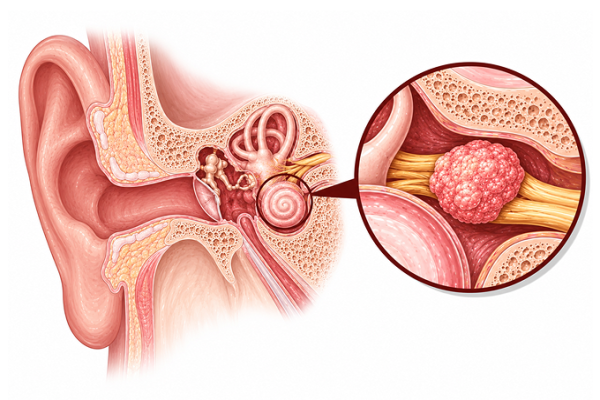
Vestibular schwannoma (acoustic neuroma) is a benign tumor of the vestibulocochlear nerve. Learn about its causes, symptoms, treatment, and prognosis at Guangzhou Fosun Chancheng Hospital.
Vestibular schwannomas (VS) are benign tumors arising from Schwann cells of the vestibular division of CN VIII, typically at the Obersteiner-Redlich zone (glial-Schwann cell junction) within the internal auditory canal:
NF2 Gene Mutation: Biallelic inactivation of NF2 tumor suppressor gene on chromosome 22q12. Loss of merlin/schwannomin protein leads to uncontrolled Schwann cell proliferation. Somatic NF2 mutations in 60% of sporadic VS.
Neurofibromatosis Type 2: Autosomal dominant disorder. Bilateral VS are pathognomonic. ~50% of NF2 patients have no family history (de novo mutation). Associated with meningiomas, ependymomas, spinal schwannomas, cataracts. Earlier onset (20s-30s vs. 50s for sporadic).
Sporadic VS: 95% of all VS are unilateral and sporadic. No identified environmental or lifestyle risk factors. Previous speculation about cell phone use not substantiated. Incidence ~1-2/100,000/year, likely increasing due to improved MRI detection.
Growth Patterns: Highly variable. 40-50% demonstrate no growth over 5 years, 30-40% grow slowly (1-2 mm/year), 10-20% grow more rapidly. Cystic VS tend to grow faster. Growth can be discontinuous with periods of quiescence.
Hearing Loss: Most common presenting symptom (90-95%). Typically unilateral, progressive, high-frequency sensorineural hearing loss. May be sudden in 5-15%. Retrocochlear pattern on audiometry (poor word recognition disproportionate to pure tone threshold).
Tinnitus: Present in 60-70%. Usually unilateral, high-pitched, continuous. May precede hearing loss. Often described as ringing, buzzing, or hissing.
Vestibular Symptoms: Vertigo/dizziness present in 20-40%. More commonly, unsteadiness or imbalance rather than true rotational vertigo (due to slow compensation). Rarely sudden vestibular failure if tumor occludes labyrinthine artery.
Trigeminal Nerve (CN V): Facial numbness/paresthesia (V2/V3 distribution), decreased corneal reflex (V1). Occurs when tumor extends into CPA, compressing trigeminal nerve. Late finding.
Facial Nerve (CN VII): Facial weakness/paralysis late and uncommon despite tumor origin near facial nerve. Hemifacial spasm or taste disturbance rare. Facial nerve remarkably resistant to compression.
Brainstem Compression: Ataxia, hydrocephalus (from 4th ventricle compression), lower cranial nerve dysfunction (dysphagia, hoarseness, aspiration), long tract signs. Indicates large tumor (>3.5-4 cm).
Observation (Wait and Scan): For small tumors (<1>2-3mm/year or symptoms progress. 50-70% do not require treatment.
Stereotactic Radiosurgery (SRS): For tumors <3cm>95%. Trigeminal nerve preservation >95%. Risks: transient tumor swelling (10-15%), delayed hearing loss, very low malignant transformation risk.
Microsurgery: Indicated for large tumors (>3cm), brainstem compression, or cystic tumors. Surgical approaches: retrosigmoid (hearing preservation possible), translabyrinthine (sacrifices hearing, best facial nerve visualization), middle fossa (small intracanalicular tumors, hearing preservation). Facial nerve monitoring essential. Gross total resection goal; near-total if facial nerve at risk.
Combined Approach: Planned subtotal resection (debulking brainstem component) + SRS for residual. Minimizes facial nerve risk while maintaining tumor control.
Sporadic VS (SRS): 5-year tumor control 95%, 10-year 90-95%. Hearing preservation 50-70% at 5 years. Facial nerve preservation >95-99%. Very low malignant transformation risk.
Sporadic VS (Microsurgery): Gross total resection recurrence <1>
NF2-Associated VS: More aggressive. Bilateral hearing loss inevitable without intervention. Earlier onset, faster growth. Multimodality treatment needed (multiple surgeries, SRS, auditory brainstem implants). Lifespan shortened but improving with modern management.
Prognostic Factors (favorable): Small tumor size, good pretreatment hearing (AAO-HNS Class A/B), sporadic (non-NF2), younger age, no cystic component, slow/stable growth pattern.
Prognostic Factors (unfavorable): NF2, large tumor, poor pretreatment hearing, cystic component, rapid growth, brainstem compression, older age with comorbidities.
Monitoring Protocol: MRI with gadolinium (thin cuts through IAC/CPA). Initial follow-up scan at 6 months to establish growth rate. If stable, annual MRI for 2-3 years, then every 2 years. Audiometry at each follow-up.
Hearing Preservation Strategies: Treat when hearing still serviceable. SRS offers better hearing preservation than surgery for small tumors. Contralateral ear protection (avoid noise trauma, ototoxic medications when possible).
Facial Nerve Monitoring: Intraoperative EMG monitoring during microsurgery critical. Baseline and postoperative facial function (House-Brackmann grading). Eye protection if facial weakness (lubrication, taping, tarsorrhaphy if needed).
Post-SRS Monitoring: Transient tumor expansion (pseudoprogression) 3-12 months post-SRS is common. Monitor with serial MRI. Steroids for symptomatic swelling. Avoid premature surgical intervention for pseudoprogression.
Balance Rehabilitation: Vestibular rehabilitation therapy for persistent imbalance. Preoperative vestibular function testing. Postoperative fall prevention measures. Vestibular suppressants for acute vertigo (short-term use only).
NF2 Considerations: Genetic counseling. Annual brain and spine MRI. Ophthalmologic evaluation (cataracts, retinal hamartomas). Family screening. Multidisciplinary NF2 clinic if available.
Concerned about Vestibular Schwannoma? Submit your medical records for a professional evaluation.
Upload Documents View Patient CasesPrepare pathology reports, imaging scans, genetic testing reports and prior treatment records for faster review.