
Global Medical Services
International Medical Center
 Diseases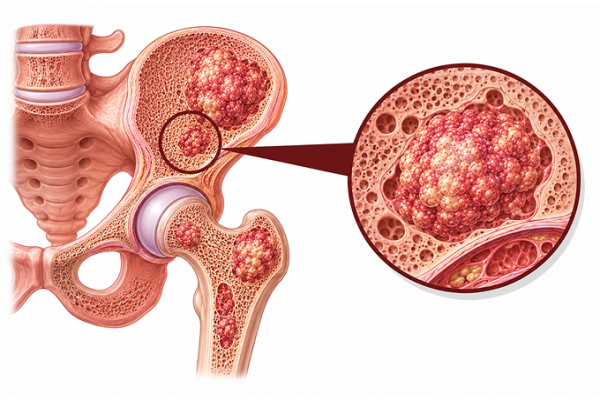
Bone metastasis occurs when cancer cells spread to bones from primary tumors. Learn about its causes, symptoms, treatment options, and management at Guangzhou Fosun Chancheng Hospital.
Bone is the third most common site of metastasis after lung and liver. Bone metastases result from hematogenous dissemination of cancer cells to the bone marrow microenvironment:
Primary Sources: Breast (65-75% of metastatic breast cancer), prostate (65-75% of metastatic prostate cancer), lung (30-40%), kidney (20-25%), thyroid (40%), multiple myeloma. Less common: bladder, melanoma, GI cancers. Distribution parallels red marrow distribution: spine (most common), pelvis, ribs, skull, proximal femur, humerus.
Mechanism - Vicious Cycle: Tumor cells secrete PTHrP, IL-6, IL-11, TNF-α, stimulating RANKL expression by osteoblasts/stromal cells. RANKL activates osteoclasts via RANK receptor, causing bone resorption. Bone matrix degradation releases TGF-β, IGF-1, BMPs, calcium which further stimulate tumor growth. This self-perpetuating cycle drives osteolytic metastases.
Osteoblastic Metastases: Prostate cancer predominantly. Tumor-derived endothelin-1, BMPs, Wnt proteins, and PSA stimulate osteoblast activity and inhibit osteoclasts. Results in excessive, disorganized woven bone formation.
Molecular Mediators: RANK/RANKL/OPG pathway central to osteoclast regulation. Chemokine receptors (CXCR4/CXCL12) direct tumor cell homing to bone. Integrins (αvβ3) mediate adhesion. Matrix metalloproteinases (MMPs) facilitate invasion.
Bone Pain: Most common symptom. Dull, constant, worse at night, poorly localized initially. Progressive, not relieved by rest (distinguishes from mechanical/degenerative pain). Movement exacerbates. Often precedes radiographic changes.
Pathologic Fracture: Occurs with minimal or no trauma. Most common in weight-bearing bones: proximal femur, vertebral bodies, humerus. Presents with sudden severe pain, deformity, loss of function. Femur fracture: inability to bear weight. Vertebral fracture: acute back pain, kyphosis, height loss.
Metastatic Epidural Spinal Cord Compression (MESCC): Back pain (90%, often precedes neurological symptoms by weeks to months), radicular pain, motor weakness (paraparesis/paraplegia), sensory level, bowel/bladder dysfunction (late). Oncologic emergency: neurological outcome depends on pretreatment neurological status. Suspect in any cancer patient with new back pain.
Hypercalcemia: Nausea, vomiting, constipation, polyuria, polydipsia, confusion, lethargy. Most common in breast, lung, RCC, multiple myeloma, and squamous cell cancers. Results from extensive osteoclastic bone resorption ± PTHrP secretion.
Other: Bone marrow infiltration: anemia, thrombocytopenia, leukoerythroblastic blood film. Nerve root compression: radicular pain, sensory loss, weakness in corresponding dermatome/myotome.
Systemic Anti-Cancer Therapy: Treatment of underlying primary malignancy with chemotherapy, endocrine therapy, targeted therapy, or immunotherapy. Denosumab (RANKL inhibitor) 120 mg SC monthly or zoledronic acid (bisphosphonate) IV monthly. Both reduce SRE risk by 30-40%. Denosumab superior to zoledronic acid for SRE prevention.
Radiation Therapy: Palliative EBRT for painful bone metastases: 8 Gy single fraction equally effective as 30 Gy/10 fractions for pain relief. Stereotactic body RT (SBRT/SABR) for oligometastatic spine disease or radioresistant tumors (RCC, melanoma, sarcoma). Hemibody irradiation for diffuse painful metastases.
Radionuclide Therapy: Radium-223 (alpha-emitter) for castration-resistant prostate cancer with symptomatic bone metastases and no visceral metastases. Improves OS and time to first SRE. Samarium-153 and strontium-89 (beta-emitters) for diffuse bone pain from blastic metastases.
Surgery: Prophylactic fixation for impending pathologic fracture: Mirels criteria (site, pain, lesion size, radiographic pattern). Intramedullary nailing or prosthetic replacement for actual fractures. Spinal decompression + stabilization for metastatic epidural spinal cord compression (MESCC). Vertebroplasty/kyphoplasty for painful vertebral compression fractures.
Pain Management: WHO analgesic ladder. NSAIDs, opioids, adjuvant analgesics (gabapentin, pregabalin for neuropathic component). Corticosteroids for spinal cord compression and pain flares from RT.
Median Survival by Primary: Breast: 2-3 years (ER+ longer). Prostate: 3-4 years (with effective androgen deprivation). Lung: 6-12 months. Renal cell: 1-2 years (longer with immunotherapy/TKIs). Thyroid: 2-4 years. Unknown primary: varies. Multiple myeloma: 5-8+ years.
Skeletal-Related Events (SREs): Defined as pathologic fracture, spinal cord compression, need for RT to bone, need for surgery to bone, hypercalcemia. Without bone-targeted agents: breast/prostate 40-50% SRE rate at 2 years.
Prognostic Factors (favorable): Solitary or oligometastatic bone disease, breast/prostate/thyroid primary, good performance status, no visceral metastases, hormone receptor-positive disease, long disease-free interval, normal calcium/alkaline phosphatase.
Prognostic Factors (unfavorable): Diffuse bone involvement, lung/GI/unknown primary, poor performance status, visceral metastases, hypercalcemia, elevated LDH, spinal cord compression with paraplegia, rapidly progressive disease.
Spine Instability Neoplastic Score (SINS): 6 parameters (location, pain, bone lesion type, radiographic alignment, vertebral body collapse, posterolateral involvement). Score 0-18: 0-6 stable, 7-12 indeterminate, 13-18 unstable. Surgical consultation for scores ≥7.
Screening and Monitoring: Whole-body bone scan (Tc-99m MDP) or NaF PET/CT for screening and surveillance. FDG PET/CT superior for lytic metastases (lung, breast, RCC) and treatment response. MRI for spinal cord compression evaluation (gold standard). Plain films for fracture assessment.
Dental Evaluation: Required before initiating bisphosphonates or denosumab. Dental examination, necessary extractions completed, and healing before first dose. Medication-related osteonecrosis of the jaw (MRONJ) risk 1-5% with prolonged use. Maintain good oral hygiene, avoid dental extractions while on therapy.
Calcium and Vitamin D: Supplement calcium (1200-1500 mg/day) and vitamin D (800-2000 IU/day) for all patients on denosumab or bisphosphonates. Monitor for hypocalcemia (more common with denosumab, especially in vitamin D deficiency, renal impairment, or high bone turnover). Routine calcium monitoring.
Renal Function: Monitor creatinine before each zoledronic acid dose. Dose adjustment for renal impairment. Contraindicated if CrCl <30>
MESCC Recognition: Educate all patients with known bone metastases about MESCC symptoms. Back pain in cancer patient = MESCC until proven otherwise. Emergent whole-spine MRI (not CT, not plain films) for suspected MESCC. High-dose dexamethasone (16 mg daily or 10 mg IV load then 4 mg q6h) for suspected MESCC. Surgical decompression + RT superior to RT alone for appropriate surgical candidates (Patchell criteria).
Rehabilitation: Physical therapy for mobility and strength. Occupational therapy for activities of daily living. Fall prevention: home safety assessment, assistive devices. Bracing for spinal instability. Weight-bearing restrictions after surgery.
Concerned about Bone Metastasis? Submit your medical records for a professional evaluation.
Upload Documents View Patient CasesPrepare pathology reports, imaging scans, genetic testing reports and prior treatment records for faster review.